London sits on some of the hardest water in the UK. Thames Water reports hardness levels of around 250-300 mg of calcium carbonate per litre in most of the capital, which is why kettles here fill up with chalky white deposits faster than almost anywhere else in the country. If you have spotted white flakes floating in your tea, that is limescale breaking loose from the element and the walls of your kettle.
The good news: you do not need expensive products to fix it. Two things you probably already have in your kitchen, lemon and white vinegar, dissolve limescale effectively. This guide walks you through both methods, plus a commercial option for heavy build-up, and explains how often to descale so the problem never gets out of hand again.
Why You Should Descale Regularly
Limescale is calcium carbonate left behind when hard water is heated and evaporates. It is not harmful to drink in small amounts, but it causes three practical problems.
First, it makes your kettle slower and more expensive to run. Scale acts as an insulating layer between the heating element and the water, so the kettle has to work harder and longer to reach the boil. A heavily scaled element can add noticeably to boiling time and energy use.
Second, it shortens the life of the appliance. Elements coated in scale overheat, and many kettles fail early for exactly this reason.
Third, it ruins your drinks. Flakes of scale end up in your cup, and tea brewed in a scaled kettle often tastes flat or slightly chalky. Regular descaling keeps water tasting clean and your kettle boiling quickly.
Method 1 – Descaling a Kettle with Lemon
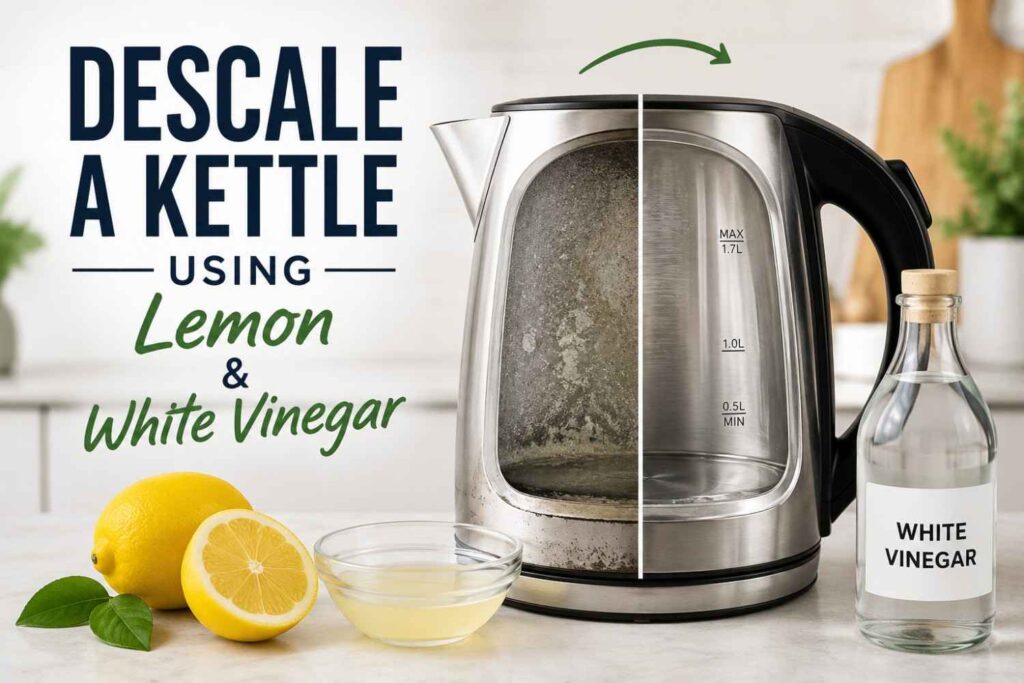
Lemon is the gentler, better-smelling option, and it works because citric acid dissolves calcium carbonate. It suits light to moderate build-up.
- Slice one fresh lemon into thin rounds, or use about 30 ml of bottled lemon juice.
- Fill the kettle halfway with water and add the lemon slices or juice.
- Boil the kettle, then leave the solution to sit for at least one hour. For thicker scale, leave it overnight.
- Empty the kettle and rinse it thoroughly two or three times with fresh water.
- Boil a full kettle of clean water and pour it away before making your next cuppa.
If patches of scale remain, rub them gently with the cut side of a lemon half; the combination of acid and light abrasion lifts stubborn spots without scratching the interior.
Method 2 – Descaling a Kettle with White Vinegar
White vinegar contains acetic acid, which is slightly stronger against limescale than lemon and better for heavy build-up. Avoid malt or balsamic vinegar; plain distilled white vinegar is what you need.
- Mix equal parts white vinegar and cold water, enough to cover the scale line inside the kettle.
- Bring the mixture to the boil, then switch the kettle off.
- Leave it to work for at least one hour. Overnight is ideal if the scale is thick or crusty.
- Pour the solution away. Most of the scale will come with it; wipe away any loose flakes with a soft cloth.
- Rinse the kettle thoroughly, then boil and discard one or two full kettles of fresh water to remove any vinegar taste.
One tip from our cleaning teams: open a window while the vinegar boils. The smell is harmless but sharp, and good ventilation clears it in minutes.
Method 3 – Using a Commercial Descaler
For kettles that have not been descaled in a year or more, a commercial descaler is the fastest route. Products based on citric acid or lactic acid are effective and food-safe when used as directed.
Follow the instructions on the packet exactly, as concentrations and contact times vary between brands. As a rule you will dissolve the product in water, boil or soak, then rinse thoroughly. Always check that the product is suitable for your kettle type; some descalers are not recommended for kettles with exposed elements.
Whichever method you use, never scrape scale off with a knife or metal scourer. Scratches in the interior give new scale extra surface to grip, so the problem returns faster.
How Often Should You Descale?
In a hard water area like London or Croydon, descale your kettle every four to six weeks if you use it daily. In softer water areas, every two to three months is usually enough. A practical rule: the moment you see a white film forming on the element or around the waterline, it is time.
You can slow the build-up between cleans by emptying the kettle after each use rather than leaving water standing in it, and by using filtered water if you already have a filter jug at home.
A scaled kettle is usually a sign the rest of the kitchen is due some attention too. Limescale that shows in the kettle is also forming in your taps, dishwasher and washing machine. Read more: How to Get Rid of Limescale from Taps and Showers.
FAQ
How often should I descale my kettle?
Every four to six weeks in hard water areas such as London, or every two to three months in soft water areas. Descale immediately if you see white flakes in the water or a chalky film on the element.
Is lemon or vinegar better for descaling?
Vinegar is slightly stronger and better for heavy build-up, while lemon is gentler and leaves a fresher smell. For a kettle descaled regularly, lemon is usually enough; for a kettle neglected for months, start with vinegar.
Can I drink water after descaling?
Yes, once you have rinsed the kettle properly. Rinse two or three times, then boil and discard one full kettle of fresh water. After that the water is completely safe and any residual taste is gone.
Why does my kettle have white flakes?
The flakes are limescale, calcium carbonate deposited by hard water, breaking away from the element and walls of the kettle. They are not dangerous but they signal that a descale is overdue.
Does descaling damage the kettle?
No. Lemon, white vinegar and citric-acid descalers are all gentle on stainless steel, plastic and glass kettles when rinsed properly. What damages kettles is the opposite: leaving scale to build up until the element overheats.
Keep the Whole Kitchen Limescale-Free
Descaling the kettle takes ten minutes, but hard water affects every appliance and surface in a London kitchen. If your taps, sink, hob and oven need the same attention, our team can handle it in a single visit.
Book a kitchen deep clean with Eco-Fresh — vetted, insured local cleaners working seven days a week across Croydon and London. Get your free quote today or call +44 7490 854 937.
Read more: Deep Cleaning in London | Oven Cleaning in Croydon
The objective of cleaning is not just to clean, but to feel happiness living within that environment. Clean carpets do exactly that. They transform your room into a fresh, healthy sanctuary. Regular care removes hidden allergens, brightens your space, and creates a peaceful, comfortable home where you can truly relax.